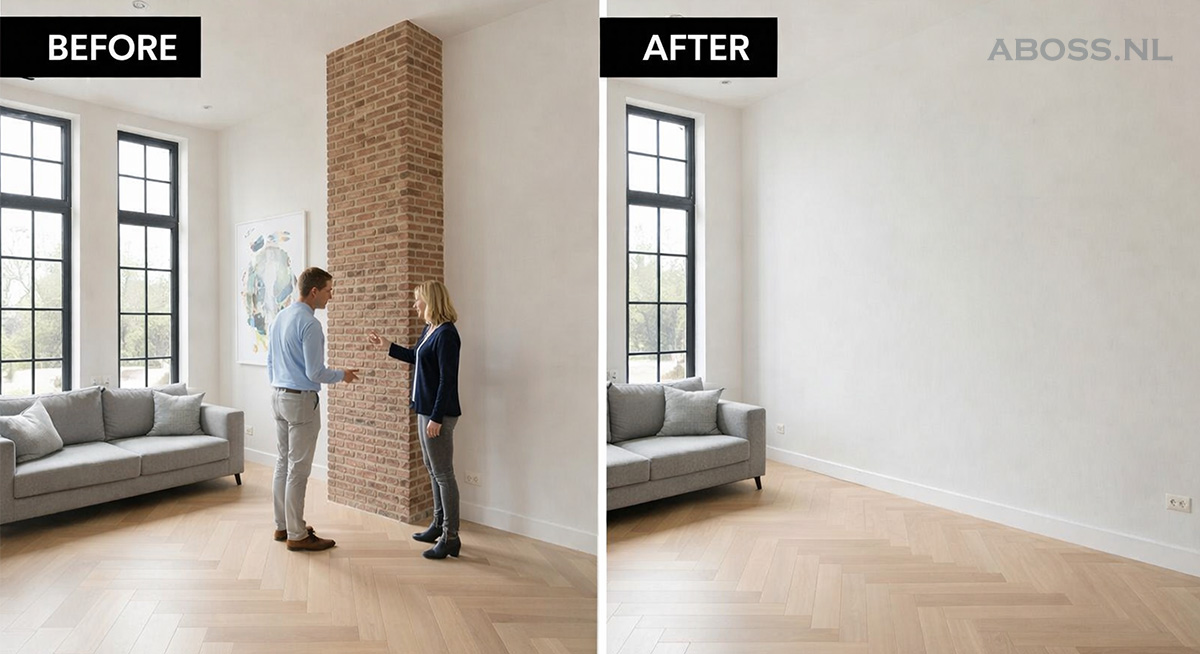
Chimney removal • Steel support • Permit-ready file

Chimney removal: structural safety and steel support

Chimney removal is not “simple demolition” — it is a structural intervention. Without a structural calculation and a temporary support strategy, the risk is real: instability, cracking, neighbour damage, and (in the Netherlands) enforcement or a stop-work order.

Applicable to houses and apartments, including shared chimneys (party walls) and heritage / protected cityscape contexts.

Steel support structure for a partially removed chimney

Structural calculation

We calculate the steel support system (beam or frame) and verify bearings, load transfer, and the capacity of the existing structure. The objective is clear: predictable behaviour in the final condition and clear evidence for municipal review.

  • Steel member sizing (often HEA/HEB depending on span and loads)
  • Bearing checks and local crushing / masonry verification (where relevant)
  • Load path verification to floors, walls, and roof structures

Temporary propping plan

The critical risk window is demolition and installation. We define the sequence, propping locations, and temporary supports so the permanent load path is never “interrupted” in an uncontrolled way.

  • Demolition sequencing (safe order of removal)
  • Temporary supports and props (positions and intent)
  • Contractor-executable plan with clear drawings

Permit-ready file

Where required, we deliver a submission package for the Omgevingsloket route: structured drawings, calculation memo, and a concise explanation that aligns with municipal assessment practice.

  • Structural drawings (bearings, connections, openings)
  • Calculation report (PDF) + design assumptions
  • Support for municipal questions / additional information requests

Regulatory and permit context (Netherlands)

In the Netherlands, structural safety during (and after) modifications is assessed under the Besluit bouwwerken leefomgeving (Bbl). Even if a project is “minor” visually, a change in load path can trigger a requirement for structural substantiation, and in some cases a permit or formal notification route under the Omgevingswet.

  • Structural change: if removal affects stability, bearing walls, floors, roof structure, or a shared structure, a calculation is normally expected.
  • Party wall / shared chimney: liability risk increases; you must demonstrate that neighbour stability is not reduced.
  • Heritage / protected cityscape: an external chimney can be a façade-defining element; partial retention or restoration detailing may be required.

Practical rule: “no exterior change” does not automatically mean “no structural file”. Municipal inspectors typically verify that the steel support and temporary propping match the engineer’s drawings.


Important safety note: flues and hazardous materials

Before demolition, confirm whether the chimney still serves a fireplace, stove, boiler, or ventilation flue. Also be aware that older flue liners may include materials that require controlled removal. If there is any doubt, we advise an inventory check before work starts.

Workflow: from assessment to execution set

  1. Assessment: chimney position, storeys, adjacent structures, flue function, and the existing load-bearing system.
  2. Design concept: select support strategy (beam/frame), define bearings, and map the load transfer.
  3. Temporary phase: set demolition sequence and propping plan for safe installation.
  4. Deliverables: calculation + drawings (PDF), contractor-ready and (if required) suitable for submission.

Local context: Amsterdam and surrounding municipalities

In Amsterdam, chimney removals are frequently reviewed conservatively where there is party-wall risk, protected streetscapes, or older building stock with slender masonry and timber floors. A clear, well-structured structural file reduces delays and makes it easier for building control to verify the work on site.

  • Typical review focus: stability, bearing details, sequencing during demolition, and neighbour risk control.
  • Heritage sensitivities: façade elements and roof silhouettes may require additional justification or detailing.
  • Execution reality: a propping plan is often the difference between a clean inspection and an enforced “fix first” order.

Typical chimney-removal scenarios

Apartment buildings (party walls)

  • Shared chimneys and interconnected masonry stacks
  • Removal at one level while retaining above
  • Neighbour risk checks and damage prevention strategy
  • Steel beam/frame support with bearing verification

Houses (roof + floor interaction)

  • Chimneys passing through timber floors and roof structures
  • Roof repairs after removal (weatherproofing + detailing)
  • Temporary propping during demolition to control cracking
  • Permit-ready documentation when required

Frequently asked questions

Can I remove a chimney without a permit?

It depends on whether the work is considered a structural change and on the local rules and context (including heritage constraints). In practice, a structural substantiation is commonly required because the municipality must be able to verify safety during and after demolition.

How is the remaining chimney section supported?

Typically with a steel support beam or frame beneath the section that remains, with adequate bearing length on load-bearing walls or columns. The exact member size and bearing details follow from the calculation and the existing building configuration.

Why is a temporary propping plan needed?

During demolition and steel installation, the permanent load path is temporarily interrupted. The propping plan defines supports and sequencing to prevent cracking or collapse.

Do I need neighbour consent for a shared chimney?

Where chimneys or flues sit on a party wall or near the property line, shared ownership and neighbour law may apply. Consent and clear agreements reduce claims and delays; technically, you must demonstrate that the neighbour’s stability is not reduced.

Will the municipality inspect the works?

Possibly, yes. Building control may inspect on site to verify that the steel support and propping match the engineer’s drawings and calculation.

Do not take structural risks

Obtain the structural calculation and temporary propping plan before demolition starts. This prevents damage, delays, and disputes during inspection.